
Our History
Understanding CAPEA’s history illuminates how educators, midwives and advocates have shaped childbirth and parenting education across Australia for over six decades.
1961
Founded in Australia
When the first organised childbirth education association was established in Victoria
60+
Years of Leadership
Decades of advocacy, collaboration and commitment to professional childbirth education
2013
Became CAPEA
When NACE was renamed to reflect the expanded scope of childbirth and parenting education
Our Journey
From its earliest beginnings to its evolution into a recognised national professional body, CAPEA has responded to changing community needs while promoting high standards in childbirth and early parenting education.
Our journey reflects decades of leadership, collaboration, and commitment to professional practice — a story of educators working together to strengthen their role within maternity and family health services, advocate for evidence-informed education, and support families during pregnancy, birth, and early parenting.
The timeline on this page highlights key milestones in CAPEA’s development and acknowledges the individuals, initiatives and achievements that have helped shape the organisation we are today.
Early Foundations of Childbirth Education
1930s – 1960s: International pioneers who shaped the movement
The foundations of organised childbirth education emerged in the early to mid-20th century, when new approaches to labour and pain management began to challenge prevailing medical models.
Dr I.Z. Vel’vovskii
In Kharkov, developed the Psychoprophylactic Method of Childbirth (PPM), drawing on Ivan Pavlov’s theory of the conditioned response — proposing that fear and tension contributed to labour pain and that education could reduce suffering.
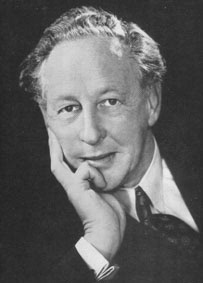
Dr Fernand Lamaze
In the 1950s, the French obstetrician introduced psychoprophylactic methods to Western audiences, emphasising breathing techniques, structured antenatal classes, and the active involvement of birth partners.
Australia’s Childbirth Education Timeline
Key milestones in the development of childbirth and parenting education in Australia
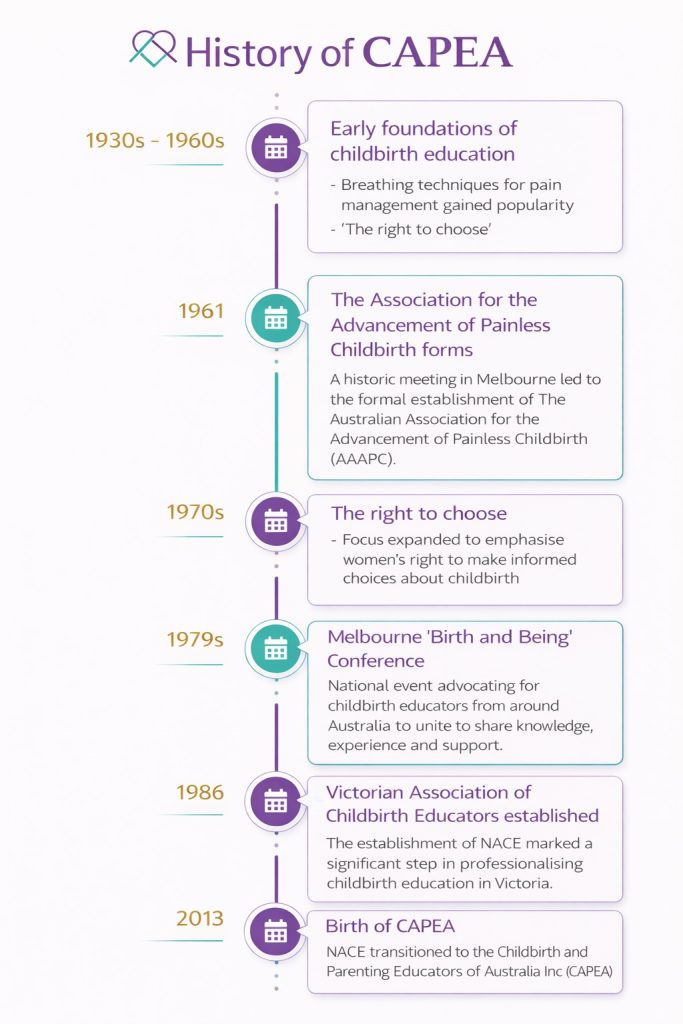
🎉 1961 — The Association for the Advancement of Painless Childbirth
In 1961, The Association for the Advancement of Painless Childbirth was established in Victoria by physiotherapists Marcelle Frame and Jean Webber. The organisation provided structured antenatal classes based on Ivan Pavlov’s theory of conditioned reflexes and the psychoprophylaxis method of childbirth preparation. As the movement evolved, the organisation was later renamed the Childbirth Education Association (CEA), reflecting its broader focus on education and professional development in childbirth preparation.
✌️ 1970 — The Right to Choice
The Childbirth Education Association (CEA) actively championed the ‘right to choose’ and promoted the concept of personal responsibility for birth. CEA brought the influential film Naissance to Australia, helping to broaden public awareness of alternative approaches to childbirth. The screening of Birth with RD Laing, which focused on the baby’s needs and a woman’s autonomy in birth, generated significant discussion and had a lasting impact on the movement.
🏢 1986 — Victorian Association of Childbirth Educators Established
The Victorian Association of Childbirth Educators was established as CEA transitioned toward a more professional organisational structure. This shift reflected a growing emphasis on professional identity and governance, alongside an ongoing commitment to consumer advocacy within maternity care.
🌎 1987 — ACEPA to NACE — Going National
In 1987, the first biennial conference for childbirth educators, ‘A Movement on the Move’, was held. This landmark event contributed to the establishment of the National Association of Childbirth Educators (NACE), representing a move away from the Australian Childbirth Education and Parenting Association (ACEPA) and signalling a stronger national professional focus for the sector.
🏫 1997 — Childbirth Educators Australia (CEA) Conference
Childbirth Educators Australia runs its first conference in Melbourne, where international experts publicise the concept of drug-free birth. This gathering further strengthened professional networks and raised the profile of evidence-based childbirth education across the country.
🎉 2013 — CAPEA is Born
In 2013, NACE was renamed CAPEA — Childbirth and Parenting Educators of Australia — recognising the expanding scope of childbirth education to include parenting education. The change reflected the evolving role of educators within maternity and family health services and marked a new chapter in national professional leadership.
To explore this history in greater depth, including the political, professional and social influences that shaped childbirth education in Victoria, we invite you to read Everything Old is New Again – An Early History of Childbirth Education in Victoria by Bronny Handfield (2013).
📚 Further Reading
To explore CAPEA’s history in greater depth, including the political, professional and social influences that shaped childbirth education in Victoria, read:
Everything Old is New Again – An Early History of Childbirth Education in Victoria
by Bronny Handfield (2013)
🏆 CAPEA Hall of Fame
Induction into the CAPEA Hall of Fame, accompanied by Lifetime Membership, represents one of the highest honours bestowed by the organisation. It is conferred only in exceptional circumstances and recognises sustained, voluntary, and distinguished service over many years.
Recipients are individuals whose commitment, leadership, and professional integrity have made a lasting contribution to the advancement of childbirth and parenting education in Australia.
| Year Awarded | Name | Presented at National Conference |
|---|---|---|
| 2001 | Bronny Handfield | Surfers Paradise, QLD |
| 2004 | Jane Svensson | Launceston, TAS |
| 2004 | Deb Galloway | Launceston, TAS |
| 2006 | Jeannie Lynch | Adelaide, SA |
| 2008 | Kim Brickwood | Melbourne, VIC |
| 2008 | Melinda Eales | Melbourne, VIC |
| 2014 | Sue Cheney | Hobart, TAS |
| 2014 | Sally Gregor | Hobart, TAS |
| 2018 | Lisa Robertson | Melbourne, VIC |
| 2019 | Dianne Haworth | Hobart, TAS |
| 2020 | Jan Dilworth | NSW |
| 2020 | Mary-Ann Baker | SA |
| 2021 | Sue Spencer | Sydney, NSW |
Explore More About CAPEA
Learn about our philosophy, goals, strategic plan, or join our community of professional educators.